

Introducing a new tool to help combat calcium instability in wine
Calcium tartrate instability in wine is a complex issue influenced by various factors. Understanding these factors and the tools available to address them is essential for producing stable, high-quality wines. This article answers key questions about calcium crystals in wine, explains how to help prevent them, and introduces a rapid analytical tool for measuring calcium concentrations in juice and wine.
Introduction
The consequences of calcium tartrate (CaT) precipitation can be significant. A winemaker may have taken the necessary steps to cold stabilise a wine, either through traditional cold stabilisation techniques or by adding a nucleation inhibitor such as carboxymethylcellulose (CMC) or potassium polyaspartate (KPA). Despite these actions, a customer or distributor may still observe crystals—which are actually CaT—at the bottom of the bottle after an unspecified period.
Calcium tartrate instability is increasingly discussed at technical forums worldwide, not because it is a new phenomenon, but because its frequency has increased. As a result, there is more discussion, research and innovation on the topic in both academic circles and among oenological product suppliers. Several factors are contributing to the rise in CaT instability, with climate change appearing to play a role.1,2 Warmer conditions and reduced rainfall create stress in the vine, altering grape composition. Relevant changes include:
- Higher calcium concentrations in juice
- Higher pH levels
- Lower malic acid
- Higher sugar levels, resulting in higher final alcohol
In addition to the grapes themselves, there are several other potential sources of calcium in wine, including winemaking practices and materials. Vineyard inputs containing calcium or carbonate, wine stored in unsealed cement tanks, and the use of calcium carbonate for deacidification can all contribute to calcium levels. Some additives, such as low-purity casein and poor-quality calcium-based bentonites, may also contribute when used at high doses.
What is the role of pH?
pH plays a significant role in CaT formation. Tartaric acid exists in three forms in wine: H2T (undissociated tartaric acid), HT− (bitartrate), and T2− (tartrate).1 Their proportions depend on pH. At an average wine pH of around 3.6, the bitartrate form typically dominates, and it is this form that binds with potassium to form potassium bitartrate (KHT), also known as potassium hydrogen tartrate.
However, tartrate ions (T2−) increase in concentration as pH rises.3 This is the form that typically binds with calcium to form CaT. Theoretically, at pH 3.2, a wine containing 60 mg/L calcium may be stable. At pH 3.8, the same calcium concentration could be problematic because more tartrate ions are available to bind with calcium. For this reason, calcium concentration alone cannot determine whether a wine will become unstable.
Likewise, a low pH does not guarantee CaT stability, as calcium tartrate instability has also been reported in sparkling wines. The issue is multifactorial.
Once CaT in the wine reaches supersaturation, it may begin to nucleate and crystallise in the absence of inhibitors. Calcium tartrate is approximately ten times less soluble than KHT—0.525 g/L4 compared with 5.2 g/L5 in water at 20°C. However, its nucleation is slower and is not significantly influenced by temperature.6 This is why CaT crystals often only become visible after bottling. The solubility of both CaT and KHT is also greatly affected by alcohol content: the higher the alcohol, the lower the solubility of these compounds.
Some wines with high calcium content do not show instability because wine contains inhibitory compounds that can slow or prevent crystallisation.7 These include citric and malic acids, as well as polyphenols, proteins and polysaccharides known as protective colloids.
The removal of protective colloids through inadequate or overly aggressive filtration may also explain why instability occurs after bottling.
How high is too high?
Winemakers have several options for reducing the risk of CaT instability. Calcium levels above 60 mg/L are considered at risk, and removing excess calcium is regarded as the most effective way to reduce that risk.8 Available methods include:
- Cation exchange resins
- Electrodialysis
- Racemic tartaric acid (DL form)
- Micronised L-calcium tartrate
Each method has advantages and disadvantages, and wineries need to select the approach best suited to their production environment. Additives such as mannoproteins, CMC and KPA are useful for preventing KHT instability but have limited efficacy against CaT instability.
Racemic tartaric acid and micronised calcium tartrate are the main treatment options for reducing calcium concentration in wine. Their applications are compared below. The information relates specifically to LAFFORT® racemic tartaric acid Ca2+Stab™ and micronised calcium tartrate CaFinish™. Results from other suppliers may vary, and dosage and application should always follow the manufacturer’s recommendations.
Table 1: Racemic tartaric acid versus calcium tartrate
| CaFinish™ | ||||||
|---|---|---|---|---|---|---|
| Optimal treatment | Fermenting must | Finished wines | ||||
| Duration of treatment | 6 weeks | 2–4 weeks | ||||
| Treatment mechanism | Calcium insolubilisation | Growth of calcium crystals | ||||
| Treatment temperature | No influence of temperature | Lower than 12°C | ||||
| Cost of treatments | Moderate | High | ||||
| Risk in the case of excess | Yes | No | ||||
| Impact on acidification | High | Weak | ||||
| Maximum dose of use | – | 200 g/hL (2000 ppm) |
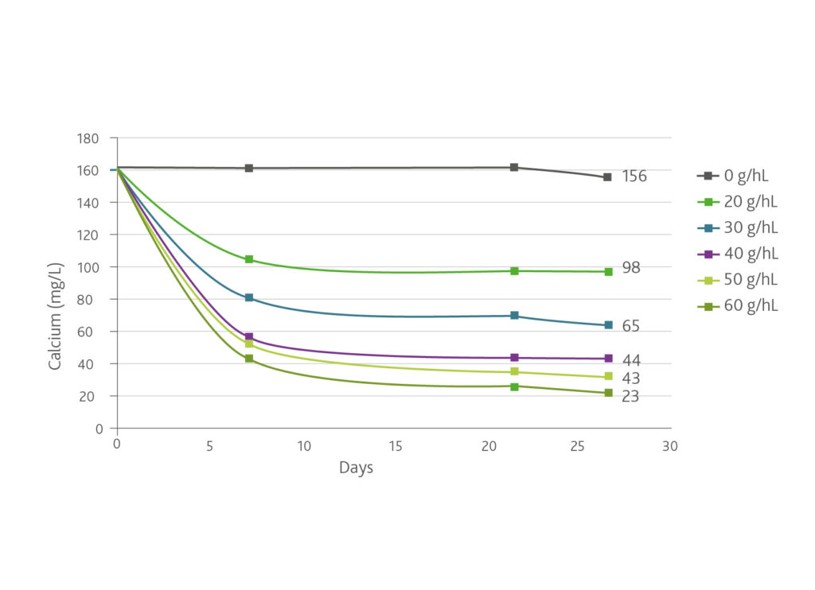
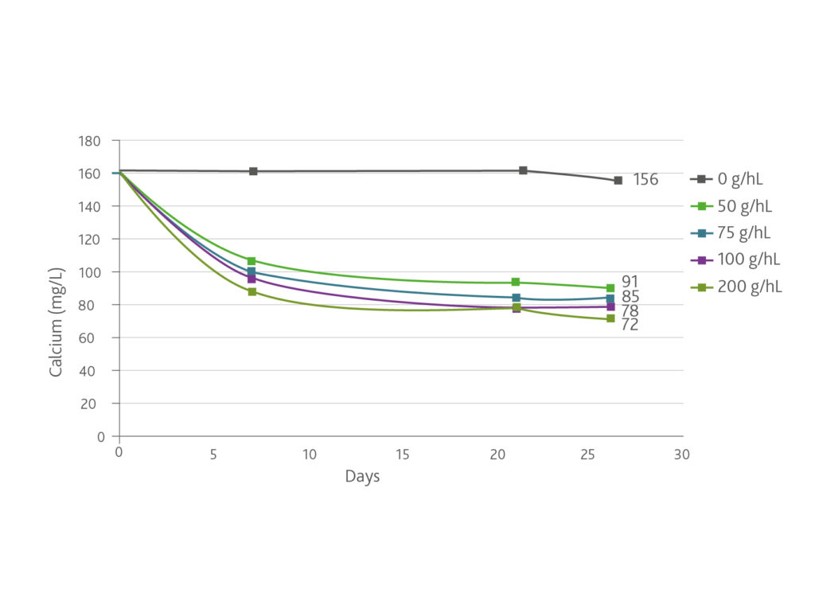
Figures 1 and 2 demonstrate the difference in efficacy between the two products. Ca2+Stab™ (racemic tartaric acid) reduces calcium levels in must or wine in a stoichiometric and proportional manner.
How can I test for calcium in wine?
Several methods are available for testing calcium ions in wine. Some laboratories may have access to complex equipment such as atomic absorption spectroscopy (AAS) or inductively coupled plasma (ICP). These techniques require significant capital investment and specialist expertise. The equipment is generally found in larger winery laboratories or research institutions, where it enables multi-element measurement. Ion-selective electrodes are portable but may produce compromised results because of the alcohol and acids present in wine.
Colorimetric analysis is a highly accurate and rapid alternative that does not require significant expenditure. Calcium readily complexes with a range of chromogens, producing a colour change. The choice of chromogen depends on the sample matrix.

Vintessential has manufactured test kits for wine analysis for more than 20 years. As calcium instability has become more prevalent, Vintessential has developed a test kit that can be used with a simple spectrophotometer or adapted to an autoanalyser, making it suitable for both juice and wine.
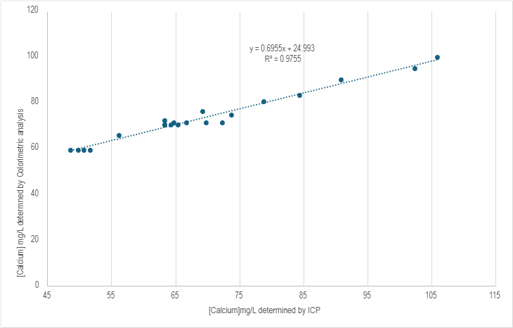
The Vintessential test kit uses a chromogen that specifically binds calcium in an acidic environment, making it ideal for wine and juice analysis. Figure 4 compares results from a range of wines and juices analysed using the Vintessential test kit with a Chemwell autoanalyser against results obtained by ICP. The test is completed in less than 10 minutes and is well suited to rapid calcium screening. When combined with basic pH analysis, it gives winemakers a practical way to assess the risk of calcium instability.
Guidelines to minimise the risk of calcium instability
Several measures can help minimise the risk of calcium instability in wine. The most important starting point is understanding the level of calcium present.
- Manage hydric stress in the vineyard. Drought and heat associated with climate change can increase grape calcium levels. Consider optimising irrigation, cover crops and soil organic matter to maintain balanced vine nutrition.
- Limit winemaking calcium inputs. Avoid or carefully control products such as calcium carbonate, low-purity casein and inferior-quality calcium-based bentonites, and verify the condition of cement tanks.
- Maintain pH and acidity balance. Biological tools such as yeast or bacteria that produce or preserve organic acids—including malic and citric acid—can help reduce the free tartrate ions available to bind with calcium.
- Preserve protective colloids. Avoid aggressive filtration and remember that common tartrate stabilisers such as CMC, KPA and mannoproteins are ineffective against CaT instability.
- Understand the risk. Measure calcium concentration, pH and alcohol. Calcium above 60 mg/L represents a risk; higher pH increases the availability of tartrate ions; and higher alcohol reduces CaT solubility.
- Actively remove excess calcium. Use targeted treatments at the correct dose, based on calcium analysis.
With continued research and practical solutions from suppliers, winemakers are better equipped to manage calcium instability effectively.
References
- Fioschi G, Prezioso I, Sanarica L, Pagano R, Bettini S, Paradiso VM. Carrageenan as possible stabilizer of calcium tartrate in wine. Food Hydrocoll. 2024;157:110403. doi:10.1016/J.FOODHYD.2024.110403
- Cosme F, Filipe-Ribeiro L, Coixão A, Bezerra M, Nunes FM. Efficiency of Alginic Acid, Sodium Carboxymethylcellulose, and Potassium Polyaspartate as Calcium Tartrate Stabilizers in Wines. Foods. 2024;13(12):1880. doi:10.3390/FOODS13121880/S1
- McKinnon AJ, Scollary GR, Solomon DH, Williams PJ. The mechanism of precipitation of calcium L(+)-tartrate in a model wine solution. Colloids Surf A Physicochem Eng Asp. 1994;82(3):225–235. doi:10.1016/0927-7757(93)02636-S
- Calcium tartrate | OIV. Accessed 30 June 2025. View source.
- Potassium hydrogen tartrate | OIV. Accessed 30 June 2025. View source.
- Calcium Instability – The Australian Wine Research Institute. Accessed 30 June 2025. View source.
- McKinnon AJ, Scollary GR, Solomon DH, Williams PJ. The Influence of Wine Components on the Spontaneous Precipitation of Calcium L(+)-Tartrate in a Model Wine Solution. Am J Enol Vitic. 1995;46(4):509–517. doi:10.5344/AJEV.1995.46.4.509
- Cataldo E, Fei M, Eichmeier A, Mattii GB, Domizio P. Understanding calcium tartrate precipitation in wines: A comprehensive study from soil and grapevine to stabilisation strategies before bottling. OENO ONE. 2026:0–.